TLDR: Static training data forces AI to guess about current events, producing hallucinations that erode trust. Connecting models to live web sources with citation tracking grounds responses in verifiable information. The infrastructure requires search APIs, multi-model routing, citation systems, and composable architecture working together.
Ask most LLM about yesterday's stock price, and you'll get an answer. Ask about today's price, and most models will guess, or worse, confidently make something up. That's the hallucination problem, and real-time data is how you solve it.
AI with real-time data connects language models to web data as it's created, not static training datasets. Responses get grounded in verifiable sources like breaking news, market changes, and operational metrics instead of generating fabricated answers.
For organizations processing millions of queries daily, this isn't optional. Accuracy depends on adapting as conditions evolve.
Why Real-Time Data is a Need (Not a Want)
By 2027, 50% of business decisions will be augmented or automated by AI agents, according to Gartner's 2025 Hype Cycle prediction. Real-time data serves as the foundation for the agentic workforce of the not-so-distant future..
Technical leaders are facing pressure to deliver AI that adapts to rapidly changing market conditions, customer behaviors, and competitive pressures. The shift from periodic analysis to continuous intelligence is well underway.
Organizations today demonstrate the imperative for real-time data through mission-critical deployments. These can be where competitive intelligence systems that track competitor pricing and product launches within minutes of announcement, investment research platforms that synthesize breaking financial news with SEC filings as they're published, or customer-facing agents that answer questions using current product availability and policy changes rather than outdated training data. These applications, and those like these, can't tolerate the inaccuracy of batch processing approaches.
How Real-Time AI Powers Business Outcomes
Analyzing yesterday's data versus responding to current conditions determines whether your AI implementation delivers competitive advantage or lags behind market realities. Real-time intelligence isn't just "faster batch." The advantages compound as scale increases, turning incremental improvements into structural differentiation.
Accurate and Current Information
Think about what happens when your AI can only reference information from its last training cutoff. For enterprise applications requiring current market intelligence, regulatory compliance information, or competitive analysis, that gap between training date and current day produces unreliable results. Real-time data infrastructure closes this gap by connecting AI systems to live web sources through APIs that surface current information with verified sourcing.
Reduced Hallucinations
Want a confident answer with no factual basis? LLM hallucinations are perfect for you. Models generate plausible-sounding but fabricated information because they're predicting likely text, not retrieving verified facts.
If you’re looking for factual answers, however, citation infrastructure reduces hallucination risk by grounding responses in verifiable sources. When your AI accesses real-time web data and provides citations for claims, you can verify accuracy and trace information back to the original source.
Adaptive Decision-Making
Historical patterns drive traditional AI recommendations, but those patterns may no longer apply. Real-time AI works differently—it processes incoming data immediately, adjusting recommendations as conditions change. Instead of a periodic reporting tool, you get an operational system that responds to evolving circumstances.
Building Real-Time AI Infrastructure
Real-time AI infrastructure separates concerns across four architectural components, each handling a distinct function. Your team can swap, upgrade, or scale individual pieces without rebuilding the entire stack.
Search APIs
When your AI needs current information, a search API for LLMs retrieves it through structured queries optimized for AI consumption. The API extracts relevant content, formats results for efficient model processing, and returns metadata—publication dates, source reliability indicators, and content categorization—alongside the information itself.
Multi-Model Orchestration
Different models excel at different tasks. Locking into only one provider could mean missing out on the most efficient or correct answer. Model-agnostic infrastructure works with any AI provider, eliminating single-vendor dependency while letting you optimize for specific use cases.
For example, a model-agnostic infrastructure routes analytical queries to models built for reasoning, while routing creative tasks to models designed for generation. The orchestration layer handles this dynamically across GPT-4o, Claude, Gemini, Llama, and others based on task requirements, speed constraints, and cost parameters.
Citation and Source Verification
Production AI systems require citation infrastructure that traces every claim to its original source. Retrieval augmented generation (RAG) infrastructure allows this by retrieving relevant documents before generation, then maintaining source attribution throughout the response. Citation infrastructure from You.com, for example, includes source URL, extraction timestamp, and relevance scoring with each response, giving organizations the audit trail they need to verify claims independently.
Composable Architecture
Monolithic vendor solutions force you into their workflow versus the other way around. Composable APIs take the opposite approach. These APIs have discrete functional components that your team assembles based on specific requirements—search, retrieval, generation, verification, etc. Combine what you need, swap components as requirements evolve, and skip the complete infrastructure replacement.
Evaluating Real-Time AI Infrastructure
When you're comparing platforms, focus on four dimensions:
- Accuracy Benchmarks: Evaluate documented performance metrics against industry benchmarks. Production-ready solutions publish scores on standardized tests like SimpleQA (which measures factual accuracy on straightforward questions) so you can compare response quality across domain-specific use cases matching your requirements.
- Compliance: Verify SOC 2 certification (the standard audit for security controls) and data retention policies. Production-ready platforms offer the option of zero data retention by processing queries through infrastructure without creating logs or storing customer data. Ask about specific controls implementing GDPR (EU privacy law), CCPA (California privacy law), and industry-specific regulations relevant to your organization.
- Integration Speed: Assess API-first design that supports existing systems without architectural overhauls. Look for RESTful endpoints, language-specific SDKs, and documented integration patterns that let your team start building in hours rather than weeks.
- Cost Predictability: Examine pricing models for transparency at scale. Per-call pricing provides predictable unit economics where you can calculate costs at any volume without hidden variables. Per-token pricing introduces complexity through input length, output length, and caching eligibility, making forecasting unreliable when scaling from pilot to production.
Start with a targeted proof of concept that validates specific business outcomes. Most successful deployments follow a pattern: infrastructure assessment first, then pilot validation with production data volumes, then scale to full organizational deployment with continuous monitoring.
Take the Next Step With Real-Time AI
The infrastructure decisions you make now determine whether your organization leads with current insights or struggles with outdated information. Successful implementations share three characteristics—modular architecture that prevents vendor lock-in, model-agnostic orchestration that adapts as capabilities evolve, and enterprise-grade reliability.
You.com provides model-agnostic infrastructure with real-time search capabilities and citation-backed results. Book a demo to see how it works.
Frequently Asked Questions
What's the difference between batch processing and real-time AI for enterprise applications?
Batch processing analyzes data in scheduled intervals (hourly, daily, weekly), whereas real-time AI processes information as it arrives. For fraud detection, this means identifying suspicious transactions in milliseconds versus hours. For customer support, it allows immediate sentiment analysis versus delayed insights.
How do we ensure data quality when processing information from multiple real-time sources?
Enterprise-grade real-time AI infrastructure requires built-in data validation, source verification, and citation tracking. The approach includes verifying sources at query time, maintaining data lineage showing information flow, and providing transparent citation trails linking each fact to its original source. Organizations should implement data governance frameworks that validate information quality at ingestion rather than attempting to clean data retroactively.
What's the typical implementation timeline for real-time AI infrastructure?
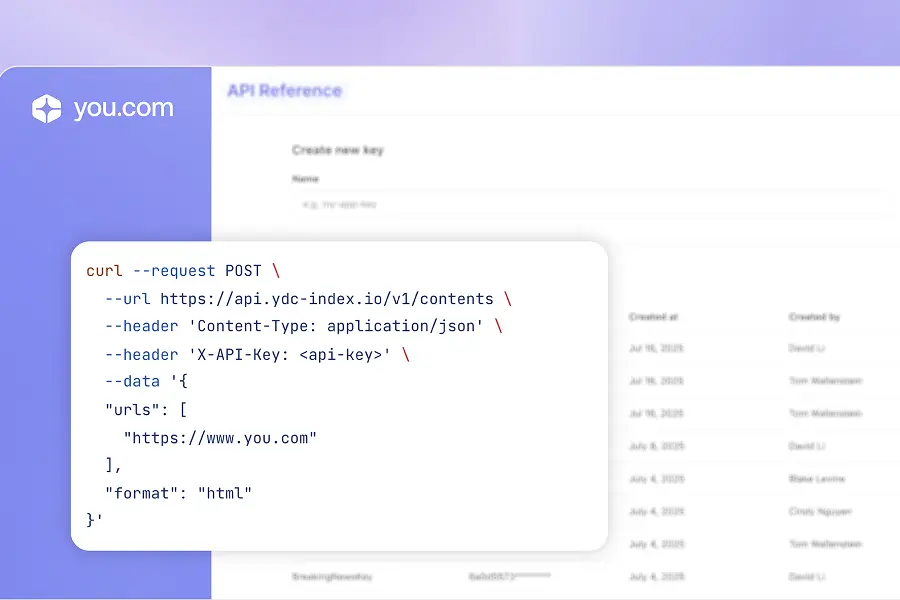
Developer integration with API-first platforms requires only API key setup, endpoint configuration, and response parsing, which takes significantly less time than traditional infrastructure deployments.
Enterprise deployments take longer because security reviews and compliance validation add necessary checkpoints, but self-service authentication tools reduce deployment friction compared to platforms requiring custom integration work.
API-first architectures integrate with existing systems without requiring full infrastructure replacement, data migration, or model retraining.
How do model-agnostic platforms prevent vendor lock-in while maintaining performance?
Model-agnostic platforms provide abstraction layers that dynamically route requests to optimal models based on use case requirements. The routing layer evaluates each query's characteristics—whether it needs deep reasoning, creative generation, speed optimization, or cost efficiency. It then selects the best available model through the same API interface.
You.com implements this through unified APIs that let your application code call one endpoint while the routing layer handles model selection based on query type, speed requirements, and cost parameters. When a provider's model quality changes or new models emerge, organizations can switch providers without rewriting application code.


.webp)

.png)




.png)