The Forward-Deployed Engineer: What Does That Mean at You.com?

LI Test
LI Test
A customer might start a conversation by saying, “We need a chatbot that searches our website.”
Requests framed this way are usually much more complex than they initially appear. What customers often actually need is closer to an AI agent that can search their public site, read internal knowledge bases, query unstructured data, handle significant traffic, follow compliance rules, and be deployed on a relatively tight timeline.
This is where Forward-Deployed Engineers (FDEs) come in.
What Is a Forward-Deployed Engineer?
The FDE role exists because there is often a meaningful gap between what an AI platform can do out-of-the-box and what a specific enterprise customer needs in practice. Even when the product has strong core capabilities, real deployments usually require custom integrations, careful handling of messy data, performance tuning, and custom work that fall outside the default experience.
FDEs work in this gap by translating platform capabilities into systems that actually fit a customer’s real environment. They are engineers who work closely with customers while still designing and building real production systems. They clarify what the customer actually needs and shape a solution that can run reliably in their environment.
FDEs own the engineering delivery of a customer project from start to finish, which includes discovery, design, implementation, testing, launch, and technical troubleshooting. They preserve context across teams so that decisions don’t get lost in translation.
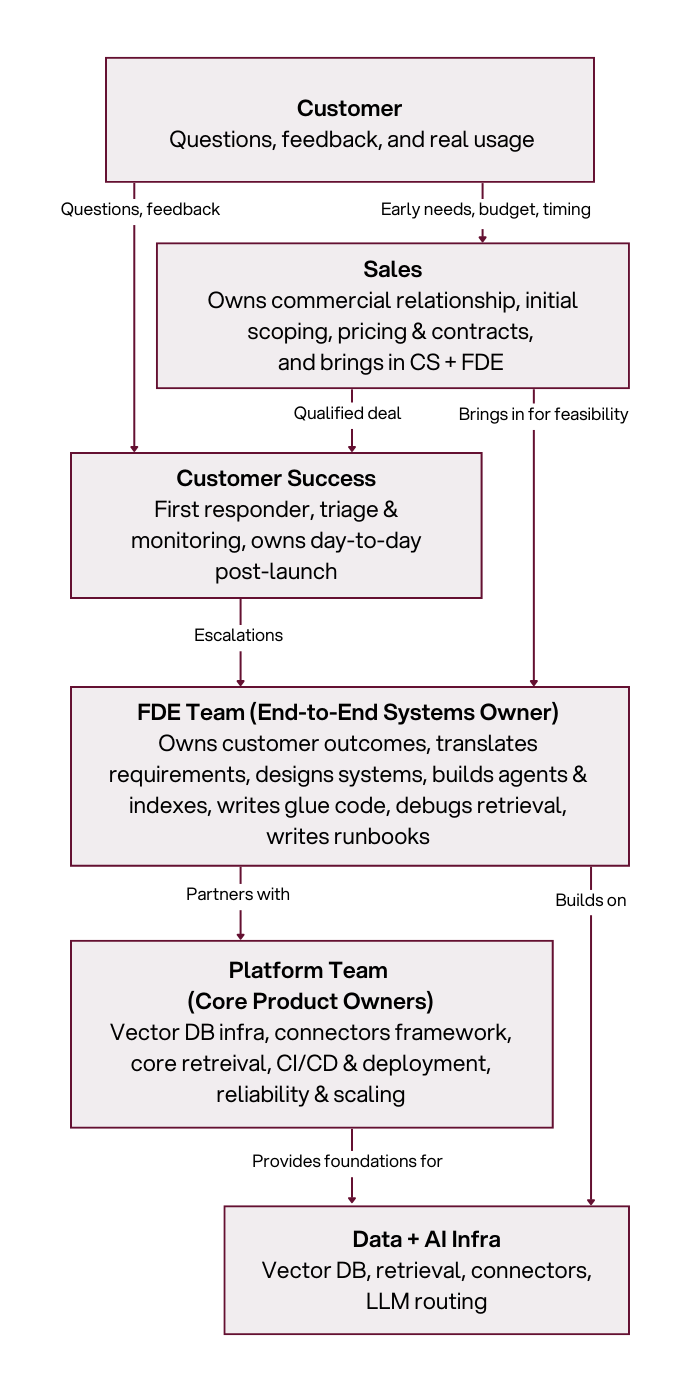
Alongside FDEs is the Customer Success (CS) team. At You.com, CS manages the ongoing relationship with the customer. They orchestrate meetings, maintain shared documentation and visibility, track milestones, manage expectations, and handle escalations, while the FDE focuses on the technical build.
How FDEs Work With Other Teams
Throughout a project, FDEs routinely interface with several groups, each with a distinct role:
- Sales: owns the commercial relationship and initial scoping. FDEs partner with Sales during qualification to assess feasibility, risk, and alignment with the product roadmap.
- Customer Success: runs the process around delivery, including scheduling, notes, coordination, risk tracking, and stakeholder alignment, and becomes the primary account owner post-launch.
- Platform, AI Search, and DevSecOps: build and maintains the reusable product capabilities, including infrastructure around retrieval and indexing, agent runtime, data connector base logic, and observability. FDEs rely on this layer and surface gaps back to Platform when recurring needs appear.
In practice, the customer works closely with both FDE and CS during delivery, while technical interaction with Platform flows primarily through the FDE.
The FDE Workflow
Phase 1: Qualification
Every engagement begins with a careful assessment of whether the project is a good fit for You.com. FDEs work with Sales to evaluate feasibility, alignment with our product direction, and overall impact.
In some cases, the requested functionality already exists on the platform and simply needs configuration. In others, it requires modest extensions to the platform. Occasionally, it involves building something entirely new.
FDEs are expected to raise concerns early if a request would create excessive custom work with limited broader value. Addressing these questions before contracts are finalized helps avoid misalignment later.
This phase also involves collaboration with customer security, compliance, and IT teams. A request that sounds like a “simple chatbot” can involve additional requirements such as SSO, data governance, or data residency constraints. Mapping these dependencies upfront is critical.
Phase 2: System Design
Once a project is approved, the FDE leads system design to develop a practical plan that reflects real enterprise constraints.
FDEs spend time understanding the customer’s infrastructure, data sources, performance expectations, and potential failure modes. They typically meet with the customer regularly in the early weeks to refine the design as new constraints emerge.
When appropriate, FDEs bring in specialists such as security engineers or backend experts to validate key decisions.
The outcome of this design phase is a comprehensive design document that includes architecture diagrams, data flows, integration points, rollout plans, rollback strategies, and success metrics.
Phase 3: Building in Iterative Cycles
With a design in place, the FDE moves into implementation, building AI agents, search indexes, connectors, and supporting services as needed.
Development happens alongside ongoing stakeholder communication. Regular demos allow customers to see progress, clarify expectations, and provide feedback before major milestones.
Customer Success is involved early so they understand how the system works well before launch. Work proceeds in cycles, with each iteration producing tangible improvements.
Phase 4: Testing
Before production deployment, the system is tested in a staging environment that closely resembles the live setup, often using real customer data under appropriate safeguards.
This testing goes beyond automated checks. It includes hands-on validation with the customer to confirm that performance, accuracy, and compliance meet expectations under realistic workloads.
A key requirement is having a clear rollback plan so that any issues in production can be addressed quickly and safely.
Phase 5: Launch and Handoff
Once the customer approves the system, the FDE oversees the production launch, monitors performance, and ensures agreed-upon service levels are met.
Ownership then transitions to Customer Success. Because they have been involved throughout the project, this handoff is typically smooth.
The FDE prepares a detailed runbook that explains the architecture, common issues, troubleshooting steps, and escalation paths. Afterward, the FDE steps back from daily operations while remaining available for critical escalations.
Phase 6: Feeding Learnings Back Into the Platform
An important part of the role is identifying which custom solutions could benefit other customers.
For example, FDEs may build a specialized data connector for one organization. If similar needs appear elsewhere, that work can be generalized and integrated into the core platform.
Over time, this process allows individual customer projects to contribute to broader product improvements.
What the Role Requires and Why It’s Important
Being an FDE involves both technical and interpersonal challenges. In addition to designing and building systems, FDEs regularly coordinate across Sales, customers, Customer Success, and core engineering teams, each of which has different priorities and timelines.
For the duration of a project, an FDE is typically embedded with a single customer. Their day-to-day attention centers on that one deployment—understanding the data, constraints, edge cases, and workflows, iterating on the design, and staying closely involved through staging, launch, and stabilization. That depth of focus is what makes the role impactful and enables FDEs to focus on one real use case at a time and see it all the way from early ambiguity to a system the business relies on in production.
Because of these requirements, You.com seeks AI engineers who are technically strong while also being effective communicators and systems thinkers. Technical depth is obviously essential, since FDEs are responsible for production-grade systems, but the ability to explain tradeoffs in accessible terms, work through uncertainty, and keep projects moving forward is equally important.
Some skills develop on the job through collaboration with other FDEs, who share patterns for handling complex customers and technical edge cases. Still, traits such as comfort with ambiguity, clear writing, and an ownership mindset are valuable from the start.
The future career paths for FDEs can vary, given that the role is relatively new in the industry. FDEs could transition into core engineering roles with deeper product insight, others could move into leadership positions, and many could remain in senior FDE roles as experts in this hybrid discipline.
For companies, especially startups, the FDE model enables teams to build alongside customers, validate needs early, and turn successful projects into scalable features.
Interested in Joining?
Forward-Deployed Engineers operate at the intersection of customer needs, product vision, and engineering execution. They take broadly stated requests and turn them into systems that are reliable, compliant, and capable of handling real-world demand. The work is demanding, involving coding, coordination, documentation, and careful decision-making. At the same time, it offers the opportunity to ship systems that matter to users.
If you’re interested in Forward-Deployed Engineering at You.com, the team is continuing to build enterprise AI solutions one customer project at a time.
Featured resources.
.webp)
Paying 10x More After Google’s num=100 Change? Migrate to You.com in Under 10 Minutes
September 18, 2025
Blog
September 2025 API Roundup: Introducing Express & Contents APIs
September 16, 2025
Blog

You.com vs. Microsoft Copilot: How They Compare for Enterprise Teams
September 10, 2025
Blog
All resources.
Browse our complete collection of tools, guides, and expert insights — helping your team turn AI into ROI.

Governing AI Isn't Optional Anymore—and the Fix Starts at the Infrastructure Layer
April 14, 2026
News & Press
.png)
Best Web Search APIs for AI Agents: What to Test Before You Commit
April 13, 2026
Blog

Building a Recursive Agent-Improvement Pipeline
April 9, 2026
Blog

Why API Latency Alone Is a Misleading Metric
April 7, 2026
Blog

What Does It Actually Take to Build AI That Works? Richard Socher Has Some Answers
April 2, 2026
News & Press
What Is Retrieval Augmented Generation (RAG)?
April 1, 2026
Blog

Building an AI Equity Research Team
March 26, 2026
Blog
.png)
When a Simple Search Isn't Enough: Building With the Research API
March 23, 2026
Blog