The Model Is the Cheapest Part of a Grounded Answer
.png)
TLDR: The Answer API returns a synthesized answer where citations are verified as a verbatim excerpt from its source. On SimpleQA, it achieves 93.14% accuracy at 2.36 seconds p50.
Synthesis over retrieved context is a narrow, high-volume task with a hard latency ceiling. The accuracy comes from the stages around the model rather than from the model itself, which is why an open-weight model, when served on infrastructure tuned for that pattern, can optimize for accuracy. We serve ours on Baseten.
This post covers the pipeline, the calculation that led us to open weights, and how we handle model selection as the frontier moves.
What Happens Every Call
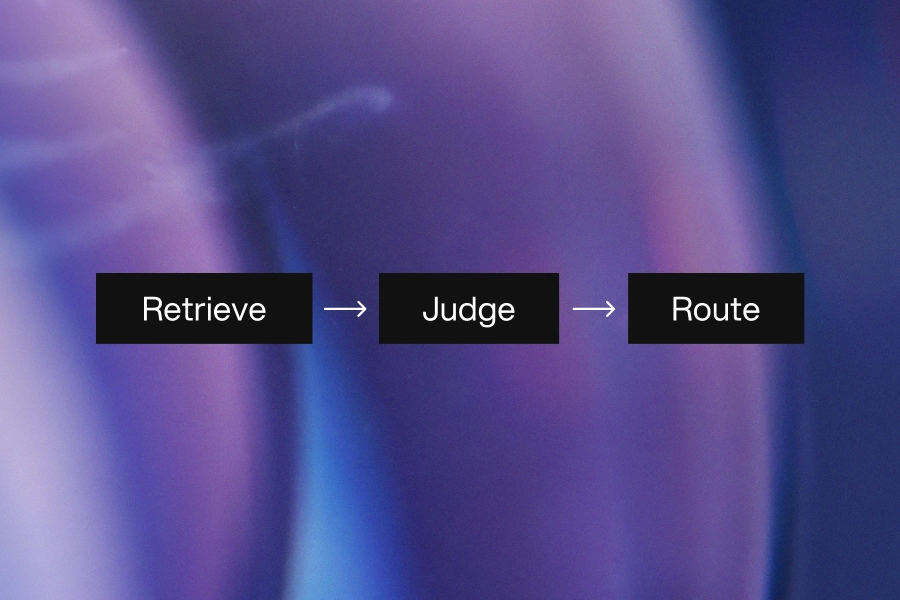
A single Answer API request runs a full pipeline: retrieval against the index, chunking, reranking, highlight selection, synthesis, and verification. Quote extraction and citation generation happen inside the verification step.
Before the response is returned, we check that the excerpts in the citations array are verbatim substrings of the source text the model was given. A paraphrased quote fails. A claim attributed to a passage that does not support it fails. The response carries those excerpts alongside the answer, so any claim can be audited against its source page.
curl -X POST https://api.you.com/v1/answer \
  -H "X-API-Key: " \
  -H "Content-Type: application/json" \
  -d '{
    "query": "What was the headline unemployment rate in the US in July 2026?"
  }'
The response, abridged to three citations:
{
  "answer": "The headline unemployment rate in the United States for July 2026 was 4.1%. [[1, 2, 3]]",
  "citations": [
    {
      "source": "https://www.axios.com/2026/08/07/bls-jobs-report-rates-july",
      "excerpts": [
        "The unemployment rate fell to 4.1% in July, the lowest jobless rate in a year."
      ]
    },
    {
      "source": "https://www.stlouisfed.org/on-the-economy/2026/aug/flash-report-unemployment-payrolls-both-drop-in-july",
      "excerpts": [
        "Unemployment again ticked down in July, with the headline rate coming in at 4.1%, its lowest level since June 2025."
      ]
    },
    {
      "source": "https://tradingeconomics.com/united-states/unemployment-rate",
      "excerpts": [
        "unemployment rate dropped to 4.1% in July 2026, down from 4.2% in June and below expectation"
      ]
    }
  ],
  "results": { "web": ["..."] }
}
The endpoint accepts the same parameters as the Web Search API (query, freshness, country, language, include_domains, exclude_domains, boost_domains). The response contains an answer field with inline numbered citations, a citations array with source URLs and verbatim excerpts, and the full set of web results considered. For field-by-field handling, see the Answer API response and citation schema.
The U.S. Bureau of Labor Statistics (BLS) released the July figure on August 7. The excerpts above come from coverage published that same day.
What the Pipeline Needs From a Model
Every stage above shapes the model requirements. Between search and synthesis, we extract the most useful context from sources for synthesis, so the model receives a bounded context budget of pre-filtered evidence rather than full page content. Verification then checks the output against that same evidence.
The model's job is bounded on both sides.
It reads the passages it receives and produces an answer in which every claim traces back to a specific excerpt. The model does not draw on world knowledge, hold a conversation, or handle open-ended instructions. The inputs are controlled, the output shape is fixed, and the operation repeats at volume against a latency ceiling that leaves synthesis a fraction of the total budget once retrieval and verification take their share.
Frontier model APIs price and optimize for open-ended generation across an enormous range of tasks. For a task this narrow, that generality is capacity we would pay for without using.
This applies to synthesis specifically. Our Research API runs multi-step investigations with cross-source reasoning and long trajectories, and while it uses multiple tools and processes, the model's capability remains relevant to the outcome.
The Calculation
For a bounded task, the question is whether a proprietary model buys enough quality to justify its cost. We run that comparison continuously across several benchmarks and serve whichever open-weight models currently clear the bar: the GPT-OSS family, the Kimi family, the GLM family, and others as they arrive.
What follows is one pairing from one benchmark, SimpleQA, included because it makes the math obvious. GPT-OSS-120b against GPT-5.4 Nano is a clear illustration because the two land close in terms of accuracy.
| Model | Accuracy | p50 latency | Input / 1M tokens | Output / 1M tokens | Cost per 1,000 calls |
|---|---|---|---|---|---|
GPT-OSS-120b | 93.14% | 2.36s | $0.15 | $0.50 | $1.33 |
GPT-5.4 Nano | 93.39% | 2.22s | $0.20 | $1.25 | $1.91 |
Cost per call assumes a context budget of 8,000 input tokens and roughly 250 output tokens, the answer plus its excerpts. For information on other models, visit the Baseten Model Library.
A single Answer API call covers search and synthesis. At these rates, synthesis alone accounts for about a quarter of what we charge for the entire call. The proprietary model would push that toward 40%, and the rest of the envelope still has to cover retrieval, reranking, highlight selection, and verification. The accuracy and latency differences are close to a rounding error at this scale, so the cost of the proprietary model is not justified.
The same math holds whichever pairing we run. Larger proprietary models score higher on open-ended benchmarks and cost considerably more, and neither property changes the outcome for a task this bounded.
The Answer API will continue to optimize for benchmark performance at low latency while remaining offerable at $5 CPM as model performance evolves. Which models we serve to hold that line will keep changing.
What Led Us to Baseten
Baseten is a production inference platform built around serving open-weight, custom, and closed-weight models at scale.
The pieces of the Baseten stack that matter most for an API workload like Answer are the following:
- Burst behavior. Answer API traffic swings by time of day and by customer, and every request triggers a full retrieve, extract, and synthesize cycle. Baseten scales GPU capacity with traffic, and its engine-level work holds throughput steady on the same hardware footprint. Multi-cloud capacity management pools GPUs across providers, which keeps tail latency within range during spikes while keeping deployments in specific regions.
- Portability. Moving between a shared Model API and a dedicated deployment is a configuration change, and the same applies to moving onto a new model. Without that, the model strategy above would be a rebuild each time rather than a redeployment.
- Data handling. Baseten operates as a subprocessor under our DPA, which is what allows us to offer Zero Data Retention on the Answer API as an enterprise add-on. Details are in our trust center.
Enterprise customers who need a fixed model for reproducibility or compliance reasons can pin one. Every model we serve runs on infrastructure we control, in regions we select, with no inference traffic reaching the labs that published the weights.
Run it Yourself
New accounts get $100 in free credits. Point your own evaluation queries at the endpoint, check the citation excerpts against the source pages, and see where latency lands for your traffic pattern.
Our eval harness and scoring code are at github.com/youdotcom-oss/web-search-api-evals, so you can reproduce the numbers above rather than take them on faith.
Answer API docs have the full parameter reference and quickstart examples in Python, TypeScript, and cURL.
LI Test
LI Test
Share Article:
Related resources.

You.com Is Now a Connector in Merge Agent Handler
October 9, 2026
Blog
Pydantic AI and You.com—Delivering Powerful Web Intelligence and Agent Orchestration
August 27, 2026
Blog
.png)
Real-Time Web Intelligence for Autonomous Agents: You.com × Sapiom
August 7, 2026
Blog
Your Trading Agent Should Read Before It Buys: Accessing You.com Over x402 on Base
August 4, 2026
Blog