TLDR: AI apps that need live web data often fail on information retrieval. You.com Web Search APIs are built to fix that by delivering structured, clean, ready-to-use web intelligence that drops in like any other dependency. They’re designed to be the web intelligence layer wherever builders are already working—like in Remy.
Remy, now compiles You.com-powered web intelligence directly into generated apps. You describe the app, Remy builds it, and You.com handles the live web layer.
AI-powered apps have a freshness problem. The LLM only knows what it was trained on and everything else—yesterday’s breaking news, for example—gets left out. To compensate, developers build retrieval layers. They wire up search providers, write parsers, and maintain pipelines. This works, but it adds weeks of infrastructure work before the product logic even starts.
Live web intelligence should compile in the same way auth or a database does. Full stop.
That’s exactly why we built the You.com Web Search APIs and it's why we're glad to be part of what Remy is creating.
What the Integration Actually Does
Remy is an AI product manager agent. The user describes an app—in plain language, in a spec, in a conversation—and Remy compiles a full-stack product. This includes backend, database, auth, and deployment, all within the Remy environment.
With You.com, Remy apps will have access to the entire web as a live data source. This means real-time retrieval across billions of pages, updated continuously.
Four purpose-built capabilities expose that at different layers of depth and structure:
- Web Search: Live, structured results for dashboards, retrieval experiences, and information feeds
- Live News: Current news data for monitoring, media analysis, and briefings
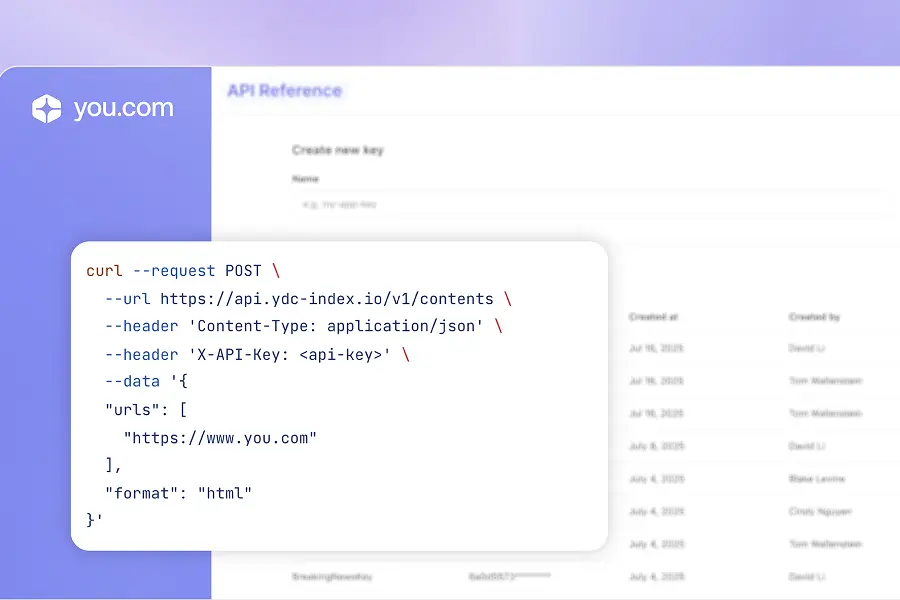
- Page Content Extraction: Clean, structured content pulled from any URL, ready to be summarized or ingested downstream
- Research: Deeper, cited responses backed by structured web retrieval
- Financial Intelligence: Finance-focused market context for fintech tools and analyst workflows
AI-First Web Search APIs
The You.com Web Search APIs were designed for AI agents that have to reason over the live web instead of just linking to it—which is an important distinction.
Linking to the web is easy. It’s a chain of commands: query, fetch, parse, chunk, rank, and inject. But each step has failure modes. Raw HTML is messy and search results often need cleaning and clarifying. When you're building a real product—one with actual users—each of those steps in the retrieval chain of commands is something you have to own, debug, and maintain.
The You.com Web Search APIs return structured, clean data instead of a wall of HTML to parse or a list of URLs to follow. They provide actual usable content, formatted for the next step in the pipeline—whether that's a language model, a database write, or a UI render.
What Builders Can Ship with You.com + Remy
Real-time web search isn't necessary for every app—but incredibly helpful for a specific category of products.
A few examples that fit especially well:
- Research Platforms: Daily briefings on emerging companies, funding rounds, or research topics, with sources cited and content structured for consumption. The kind of thing that used to require a scraper, a parser, and a weekly maintenance window
- Competitive Monitoring Tools: Tracking product launches, pricing changes, or feature releases across a set of competitors. You define the watchlist; the app handles the retrieval
- Financial Intelligence Dashboards: Live market news, sentiment, and company-level coverage aggregated into a single view. The financial intelligence capability is purpose-built for this kind of use case, not a general search endpoint repurposed for finance
- Sales Research Tools: Prospect briefs generated before every call, pulling from news, company pages, and public web content. Sales teams that have used these don't go back to manual research
- News Aggregation Products: Domain-specific feeds with auto-summarization. Niche enough to be useful; broad enough to stay current
Instead of demos or prototypes, these are real, full-stack apps with fully fleshed-out backends. The You.com layer handles keeping the data fresh, while Remy handles keeping the rest of the stack working.
How to Use You.com in Remy
There are three ways to bring You.com into a Remy-generated app, and none of them require manual API configuration:
- Describe the product. Say what you want the app to do. If the use case calls for live web data, Remy decides You.com is the right fit and integrates it automatically.
- Name it directly. Tell Remy to use You.com APIs in the app, and the integration is included in the generated spec.
- Pin it in settings. For teams running multiple projects with consistent retrieval requirements, you can configure You.com as the default so every generated app in the workspace uses it consistently.
Live Web Intelligence Should Be Compiled In
The apps people want to build are increasingly expected to have access to real-time information. Historically, however, solving that problem was its own project and before you could even write a single line of product logic, you were already stuck debugging a retrieval pipeline.
That's what we wanted to change. Live web intelligence should be something devs can compile in—the same way they compile in auth or a database—not something they spend a sprint building from scratch before the real work even begins.
If you're building apps that depend on fresh data from the web, the You.com Web Search APIs are available now and they’re part of the Remy toolkit.

.png)
.webp)







.png)