TLDR: Agentic deep research is the architectural shift from "LLM plus search" to autonomous research systems that plan queries, explore the web iteratively, reconcile conflicting sources, and generate cited reports—without waiting for human input between steps. This post covers how these systems are built, what distinguishes them from standard RAG pipelines, where they fail in production, and what real-world benchmarks reveal about the gap between adding a search tool to an LLM and actually building a research agent. If you're evaluating whether to build or integrate one of these systems, the numbers here are the ones your conversation should start with.
The Difference Between Search-Augmented LLMs and Agentic Deep Research
Ask a standard RAG pipeline to compare every AI code editor released in the past two years—pricing, supported languages, benchmark results, user reception. It will retrieve a handful of documents, generate an answer from whatever landed in the context window, and return something plausible-looking that is probably three months stale and missing half the products.
That's the hard ceiling on passive retrieval. You get one shot at the evidence. The model reasons over whatever you handed it and stops.
Agentic deep research works differently. The agent doesn't search once and reason once. It searches, reads, updates what it knows, generates new questions from what it found, searches again with better queries, and keeps going until it has enough coverage or hits a compute budget. These systems tightly integrate autonomous reasoning, iterative retrieval, and information synthesis into a dynamic feedback loop where retrieved information recursively refines the next query, and reasoning actively shapes which sources the agent pursues next.
The distinction is a different architecture with different failure modes, different cost profiles, and different integration requirements.
How the Legacy Four-Stage Pipeline Used to Work
Early deep research systems were built as an explicit four-stage pipeline: planning, question developing, web exploration, and report generation, each running as a distinct step with its own prompt and handoff to the next. Collapsing these stages was a common way to ship something that looked like a research agent but behaved like an expensive chatbot. Without a planning step to decompose the query first and reasoning over accumulated evidence without a distinct synthesis step, when user intents were complex or vague, direct retrieval often failed and tended to produce hallucinated citations and unresolved source conflicts.
This four-stage pipeline is now largely considered legacy. Modern frontier LLMs are RL-trained to run a tighter loop instead—reason, call a tool, observe the result, reason again—repeating until the model decides it has enough evidence, then producing a final synthesized answer in one pass. The four functions haven't disappeared, they're just no longer separate stages.
Instead, planning happens inside the reasoning step before each tool call, question developing happens as the model reformulates its next query based on what the last one returned, web exploration is just what the tool calls are, and report generation is folded into the model's final answer generation, where it synthesizes everything gathered across the loop using its own post-training capabilities rather than a dedicated synthesis pass.
You.com lets the LLM decide. Majority of frontier LLMs today are RL-trained to run this reason-act loop in an optimal fashion with token-usage, time, and budget in mind, so we typically don't impose the legacy four-stage structure (unless it's strictly required for the final synthesized report or a specific business use-case).
What Benchmarks Tell You
The DeepSearchQA (DSQA) benchmark, released by Google DeepMind, tests something different from most research-agent evaluations. It's a 900-prompt benchmark evaluating agents on difficult multi-step information-seeking tasks across 17 different fields. Unlike traditional benchmarks that target single-answer retrieval or broad-spectrum factuality, it features handcrafted tasks designed to evaluate an agent's ability to execute complex search plans to generate exhaustive answer lists.
Each task is built explicitly to stress three capabilities most evals ignore: systematic collation of fragmented information from disparate sources, de-duplication and entity resolution for precision, and reasoning about stopping criteria in an open-ended search space.
That third capability is where the benchmark earns its name. Each task is structured as a causal chain, where discovering information for one step depends on successful completion of the previous one, and tasks are grounded in the open web with objectively verifiable answer sets, time-anchored to static data sources to minimize the drift that live web benchmarks suffer as ground truth changes over time. Getting one fact right is a different skill from knowing when you've found all of them and can stop looking—DSQA is built to expose the gap between those two skills.
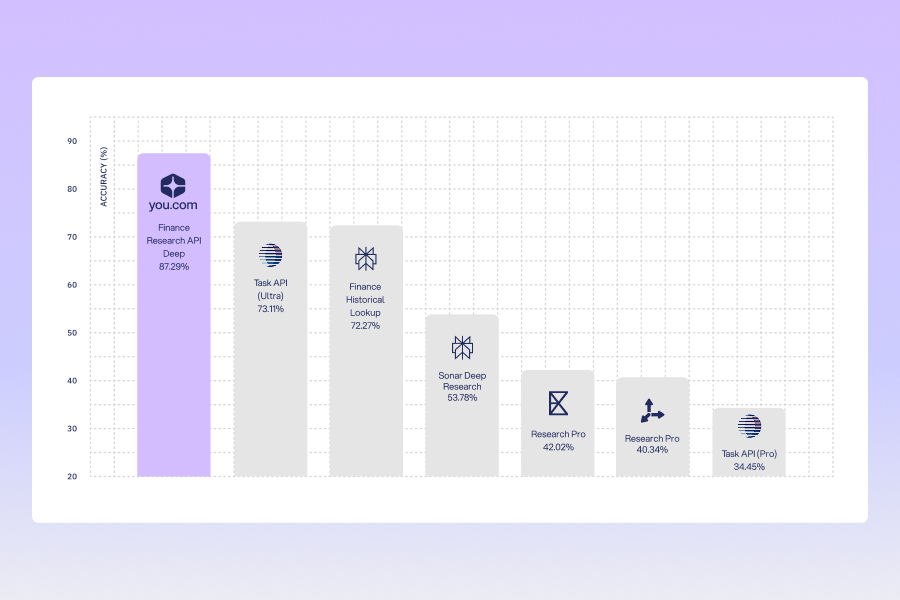
The spread across deployed systems is wide. Gemini's Deep Research API led the market at launch with a 66.1% score, with other reported results including OpenAI GPT-5.2 Pro at 61% and Perplexity Sonar Deep Research at just 25%.
The You.com Research API currently sits at the top of the leaderboard: 83.67% accuracy and a 93.16% F1 score on the full 900-prompt set, achieved through a harness built around single-agent scaling rather than multi-agent orchestration, since ensemble approaches were found to be generally compute-inefficient for agentic search tasks.
That accuracy/F1 split matters more on DSQA than on most benchmarks, because the failure modes are asymmetric. Agents commonly fail through premature stopping—under-retrieving before the answer set is complete—or through hedging—casting an overly wide net of low-confidence answers to artificially inflate recall. A benchmark scored on raw accuracy alone would let both failure modes hide behind a single number. F1 catches the second one.
Compute budget turns out to be the lever that matters most here. The You.com results scale with test-time compute—in its highest-compute configuration, the agent autonomously executes up to 1,000 iterations against a usage budget of up to 10 million tokens per session—and that scaling behavior isn't unique to one vendor's harness.
On DSQA, the model doing the reasoning doesn't matter as much as whether or not your harness treats compute budget as something an agent manages dynamically.
Where Agentic Deep Research Breaks in Production
Three failure patterns emerge consistently across deployed deep research systems.
- Retrieval loops on fact-seeking queries. SIGIR 2026 analysis found that fact-seeking sessions exhibit high repetition that increases over time, with near-duplicate query loops emerging in later steps. The agent finds enough to partially answer the question, can't find the specific fact it needs, and keeps re-querying with slight variations. Without a stopping condition tied to confidence or evidence coverage, the agent burns compute while running the same search fifteen different ways.
- Hallucinated citations under synthesis pressure. When the agent reaches the report generation stage with a large evidence buffer and a long output target, citation accuracy degrades. The model is doing two hard things simultaneously—maintaining coherent prose across a long output and accurately attributing every factual claim to a specific source. Separating the summarization step—processing each retrieved document into structured findings before the report generation pass—reduces this failure mode significantly.
- Plan injection and intent hijacking. Sophisticated plan injection and intent hijack attacks exploit intermediate planning and retrieval steps, with alignment failures confirmed across diverse base and RL-enhanced LLMs. A malicious page returned in search results can embed instructions that redirect the agent's subsequent queries. This is a live threat in any system that parses retrieved HTML as part of the agent's reasoning context, and it's one reason browser-based exploration requires more careful sandboxing than API-based retrieval.
Build vs. Integrate: The Honest Tradeoff
The choice is usually not whether to build a deep research architecture from scratch—it's whether to integrate a purpose-built research API or wire a search tool into an existing LLM pipeline and accept the performance ceiling that comes with it.
| Pathways |
Build With Search/Contents Primitives |
Integrate the Research API |
| What it is |
Construct your own agentic search architecture on top of raw search/contents primitives |
Use a purpose-built research API with planning, retrieval, and synthesis already handled |
| Time to first integration |
Slower—requires building the retrieval pipeline, query planning, and synthesis logic yourself |
Immediate—start integrating agentic search into your product from day one |
| Customization |
Highly customizable to specific business needs and workflows |
Less flexible; you work within the API's research behavior |
| Engineering effort |
Ongoing—your team owns query planning, retrieval depth tuning, evidence reconciliation, and citation accuracy |
Minimal—the API handles iterative retrieval, source reconciliation, and evidence grounding |
| Best fit |
Teams with specific architectural requirements or differentiation needs around the research layer itself |
Teams that want production-quality deep research |
Agentic search APIs—specifically designed to autonomously find, retrieve, and structure relevant information for multi-step reasoning tasks—are now the standard infrastructure layer for production research agents. The engineering work shifts from "how do I build a retrieval pipeline" to "how do I structure my agent's interaction with an API that handles retrieval well, and how do I evaluate whether it's doing what I think it's doing."
The You.com Research API is built for this integration point—handling the iterative retrieval, source reconciliation, and evidence grounding that make deep research work at production quality without requiring teams to build and maintain the retrieval infrastructure themselves. If you're evaluating whether this fits your architecture, the API documentation and a free trial are the right starting point.
The Evaluation Gap Nobody Accounts For
The failure mode that bites teams last is also the hardest to catch before launch—evaluating a research agent against queries it was implicitly optimized for, then deploying it against a broader distribution of user intent.
The SIGIR 2026 analysis of real agentic search sessions found that 88.64% of sessions are declarative (fact-seeking), 3.96% are procedural (how-to), and 7.41% are analytical (reasoning-intensive)—a distribution that is almost certainly different from whatever evaluation set was used during development. Fact-seeking sessions and reasoning sessions have very different optimal retrieval depths (7.70 vs. 24.99 documents per query on average) and very different query reformulation patterns. An agent tuned on one intent type will underperform on the others.
Designing your eval set to reflect actual production intent distribution is the same discipline as building representative eval datasets for any ML system. It's not specific to research agents.
But the stakes are higher here because the failure mode is confident, well-cited, wrong output rather than a classification error you can easily catch.
To set up your agentic systems for success, try the You.com APIs for free.
.png)






.png)

.png)

