TLDR: AI search infrastructure is a new category of technology, purpose-built for the age of artificial intelligence. It delivers deep, contextual, and actionable information to AI agents and applications—transforming how enterprises and developers access, understand, and act on data.
The Search Revolution: Why the Old Model No Longer Works
For decades, web search has been designed for one user: humans. We type a query, scan a list of links, and piece together answers ourselves. This approach made sense when people were the primary consumers of web data. But the world is changing—fast.
Today, artificial intelligence is reshaping how we work, learn, and make decisions. Soon, there will be more AI agents using the web than humans. Yep, you read that right—there will soon be more AI agents than humans searching the web.
These agents, however, don’t browse or click the same way a human would. Instead, they need direct, contextual, and actionable information to power real-time decisions and automation. The existing search infrastructure, built for human navigation and link-centric design, can’t keep up.
Shallow Search in a Deep Intelligence World
Legacy search engines were architected for a different era. They capture everything but comprehend nothing about domain context. Their indiscriminate crawling and link-based results force users—and now, AI systems—to synthesize answers from surface-level data. This “shallow search” problem creates critical gaps in enterprise intelligence and limits what AI can achieve.
Imagine an AI agent helping a retailer optimize inventory. It doesn’t just need to know that “winter coats are trending,” it needs real-time data on specific styles, regional demand, supplier availability, and market dynamics, all synthesized from public and private sources. Traditional search can’t deliver this level of depth or context.
What Is AI Search Infrastructure?
AI search infrastructure is a new category of search technology, built for the age of AI. Instead of optimizing for human browsing, it’s designed for LLMs and AI agents and applications that require deep, contextual, and actionable information from both private company data and the public web.
Core AI Search Infrastructure Capabilities
AI search infrastructure redefines how organizations and AI agents access information. Below are the essential capabilities that set a leading AI search infrastructure apart—offering deep, real-time, and customizable intelligence at internet scale, while ensuring trusted, actionable insights tailored to industry needs and privacy requirements.
Styled Table
| Capability |
What It Means |
| Accurate |
Accurate and hyper-targeted insights tailored to your industry, unique customer profiles, and solution areas. |
| In-Depth |
Unrivaled granularity and coverage, empowering your customers with 360 degree industry intelligence. |
| Customizable |
Unrivaled granularity and coverage, empowering your customers with 360 degree industry intelligence. |
| Real-Time |
Always-on, real-time intelligence that keeps your customers perpetually ahead of the market. |
| Contextual |
Delivers insights within the right industry context, making the information not just relevant, but also meaningful. |
| Action-Oriented |
Provides clear, practical insights that can be immediately applied to strategy, decision-making or operations. |
How AI Search Infrastructure Works
An AI search infrastructure is your AI stack, but the amount of orchestration or involvement needed on your end is more of a spectrum. You can opt to take a route that requires minimal orchestration (across tools, across teams, etc.) or dial up the orchestration and expertise required until eventually getting to more complex applications like advanced agents.
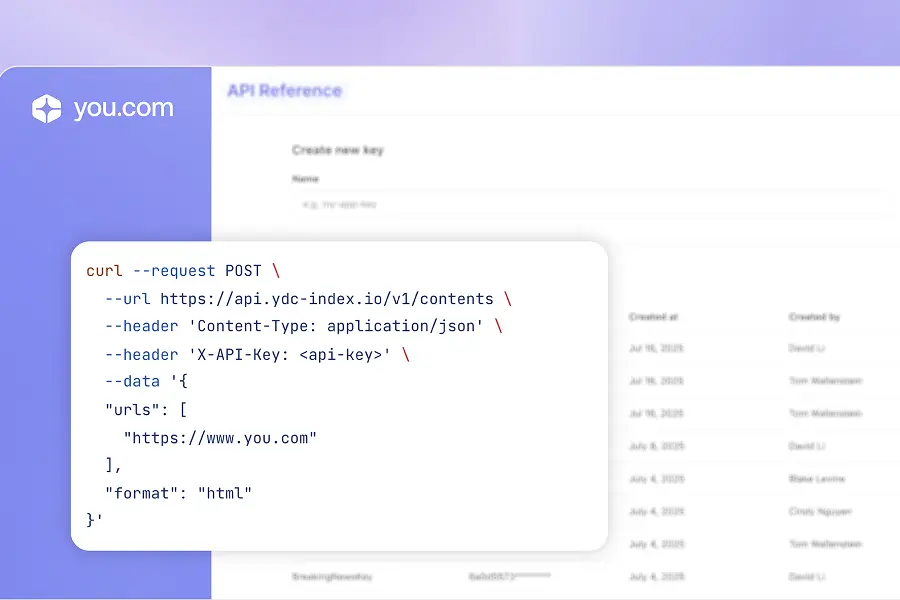
The You.com (YDC) AI Search Infrastructure, for example, is designed to work with your business needs, offering both “build” and “buy” options. Build, meaning you or your developers can build and implement yourself, or buy, meaning You.com can provide custom support to help you achieve your AI goals.
Whether you want to leverage ready-made Search APIs and vertical-specific indexes for immediate high-accuracy retrieval, or create custom solutions through private RAG, custom agents, or tailored indexes, the You.com AI Search Infrastructure empowers you to integrate deep, domain-specific knowledge and advanced search capabilities directly into your workflows.
Vertical Specific Indexes as Part of the AI Search Infrastructure
One of the biggest challenges in deploying AI for enterprise and industry-specific tasks is what we call the “AI blind spot.” Even the most advanced AI models can only be as knowledgeable as the data they are able to access.
The AI Blind Spot
Without deep, structured, and domain-specific data, language models often return shallow, outdated, or unreliable results—undermining the very business decisions they’re meant to empower. In fact, 95% of GenAI pilots fail not because the underlying models aren’t powerful, but because organizations lack the data infrastructure necessary for accurate, contextual, domain-specific reasoning.
Yep, the shallow search monster is once again rearing its ugly head.
As we know by now, traditional web indexes crawl the surface of the internet, providing unstructured and incomplete information, resulting in hallucinations or unreliable answers, leaving enterprises exposed to risk.
Industry-Specific Vertical Indexes
The key to defeating the shallow search monster lies in building industry-specific indexes—intelligent data layers that combine technical excellence and contextual enrichment at every step.
- The process starts with rich data acquisition from public sources, partner portals, and structured databases, all carefully scored for authority and freshness.
- Next, intelligent processing powers context-aware crawling, entity extraction, and semantic chunking, so the right information is always available and optimized for retrieval.
- Then, an enrichment layer organizes this data with metadata tagging and ontology mapping, capturing nuanced relationships and context.
- Finally, powerful APIs make this structured intelligence accessible for search, analytics, and agent integration—delivering LLM-ready outputs that are always fresh and deeply relevant.
With vertical indexes businesses can unlock a new class of use cases—from personalized recommendations in travel and hospitality, to contract analysis and compliance monitoring in legal and finance, to dynamic product recommendations and fraud detection in retail, and more.
Why Now? The Perfect Convergence
We’re living through a turning point that makes AI search infrastructure critical for modern businesses and developers. The rapid rise of GenAI and LLMs has created an unprecedented hunger for high-quality, contextual information—the fuel enabling these models to deliver meaningful, relevant, and actionable outputs.
As these models become more central to business and everyday life, organizations are accelerating their adoption of AI to automate complex decisions and processes. This new wave of enterprise AI depends on infrastructure that can provide real-time, trusted insights, because outdated or incomplete information simply won’t cut it for mission-critical decisions.
At the same time, the world faces a data explosion.
The sheer volume, variety, and speed of data generation has rendered traditional search approaches—designed for slow, manual browsing—obsolete. Yesterday’s search engines can’t keep up with today’s need for instant, deep, and tailored responses. Compounding this, the consumers of web data are changing: AI agents are rapidly becoming the primary users of the web. But these agents require infrastructure that’s built for their needs, able to surface structured, domain-rich, and current knowledge that can be integrated directly into automated workflows.
It’s the convergence of these trends—the generative AI boom, the enterprise drive toward automation, the relentless growth in data, and the shift towards AI-driven consumption—that makes the emergence of AI search infrastructure so timely and transformative.
You.com is Setting the Standard
As the world of search continues to evolve for the age of AI, You.com is leading the way. We’re defining what AI search infrastructure means, delivering scalable, customizable, and trusted solutions that empower enterprises and developers to unlock the full potential of intelligent, real-time information access.
The You.com AI Search Infrastructure is:
- Purpose-Built for AI: Designed from the ground up for AI agents and applications—not just human users.
- Customizable and Flexible: Enterprises can build and control their own indexes, agents, and data pipelines.
- Scalable and Trusted: Proven at internet scale, serving over a billion queries monthly and trusted by Fortune 500 companies.
- Comprehensive: Aggregates data from public web, partner portals, and specialized industry databases for a holistic view.
Ready to Lead the AI Search Revolution?
We’re moving toward a world where AI systems can seamlessly access and synthesize information from thousands of sources, understanding not just what data exists but how it relates to specific business contexts and objectives. This isn’t just an incremental improvement to search—it’s a fundamental reimagining of how intelligent systems access and process information.
The transformation has already begun. The question isn’t whether this shift will happen—it’s whether your organization will lead it or follow it.
Book a demo to learn more about how the You.com AI Search Infrastructure can propel your organization's AI implementation.


.webp)
.png)